
The IRS expects you to report taxable digital asset activity. It is important to note that not receiving a Form 1099-DA does not automatically make a DeFi transaction tax-free.
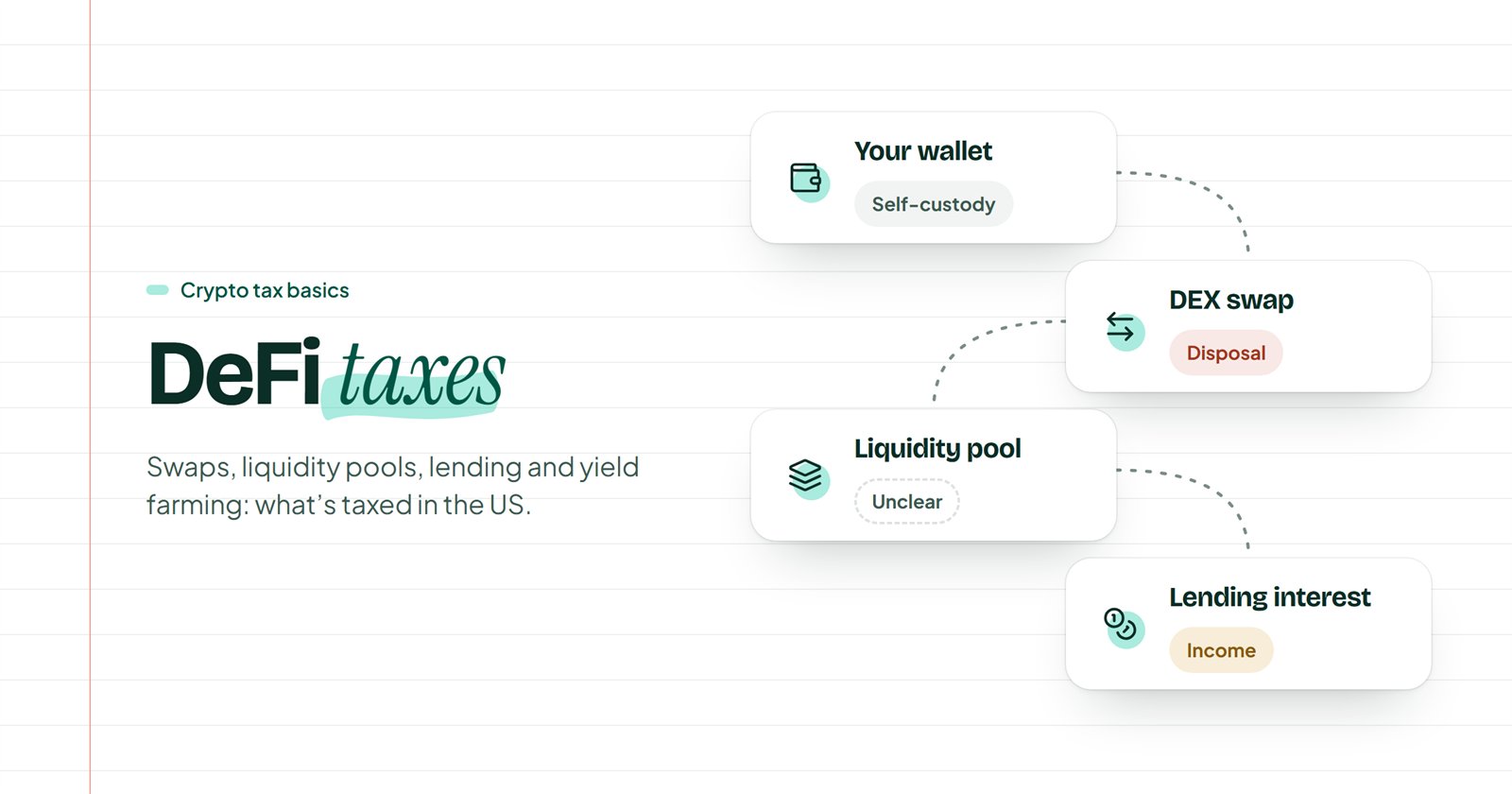
Whether a DeFi activity is taxable depends on what you did, what assets changed hands, when the transaction occurred, and the facts of the transaction. Swaps and withdrawals can create capital gains. Rewards and interest are usually ordinary income. Some areas, like liquidity pools, still have no clear IRS rule.
Quick answer:
Are DeFi Taxes Required in the US?
Yes. DeFi taxes may apply to swaps, rewards, lending income, liquidity activity, and other transactions. The important point is that DeFi does not have one universal tax rule. Each transaction needs to be reviewed based on what actually happened.
For example, swapping ETH for USDC can involve a disposal of ETH. Receiving a DeFi reward can raise a different income-tax question.
Will I get a Form 1099-DA for DeFi?
Since 2025, certain digital asset brokers have had to report transactions on Form 1099-DA. Many decentralized, non-custodial DeFi platforms that don't hold your assets are not covered by these reporting rules.
Congress cancelled the rule that would have made them in April 2025. Starting in 2026, exchanges will also report your cost basis on newly bought assets, but DeFi still won’t. No form doesn’t mean no tax. You still have to work out and report your own gains and income. Source:
https://www.irs.gov/Form1099DA
Important Note: This guide is intended for educational purposes only. It is not tax advice, and you should talk to a qualified tax professional before you file.
What Counts as DeFi?
DeFi, or decentralized finance, refers to financial applications that run on blockchain networks instead of traditional financial institutions. You can use DeFi to swap tokens, lend or borrow crypto, provide liquidity, earn rewards, and more.
Common DeFi activities include:
- Decentralized exchanges (DEXs)
- Liquidity pools
- Lending and borrowing
- Yield farming
- Staking
- Bridges
- Derivatives
- Decentralized stablecoin protocols
Why DeFi Platforms May Not Issue Form 1099-DA
Centralized exchanges send Form 1099-DA. DeFi apps usually don't. Here's why.
Form 1099-DA reporting began for certain broker transactions in 2025. For 2025, brokers report the gross proceeds from digital asset sales.
Cost-basis reporting has begun in 2026 for certain assets. However, the IRS says its broker rules apply to brokers that take possession of the digital assets being sold. See the IRS guidance on Form 1099-DA reporting.
Hence, decentralized, non-custodial platforms that never hold your assets fall outside them.
FYI: Centralized exchanges still report. Form 1099-DA began with tax year 2025, and cost-basis reporting for certain assets starts with tax year 2026.
What Happened to the DeFi Broker Rule?
December 2024: Treasury and the IRS finalized a rule that would have treated certain DeFi platforms as brokers.
March 2025: Congress passed a resolution to overturn it under the Congressional Review Act, with bipartisan votes in both chambers.
April 10, 2025: President Trump signed the resolution.
July 11, 2025: Treasury and the IRS removed the rule from the Code of Federal Regulations.
Under the Congressional Review Act, the same or a substantially similar rule cannot be brought back without new legislation.
Important: The repeal removed one reporting rule. It did not make crypto tax-free, and your duty to report gains and income hasn’t changed.
What this Means for You
Don't wait for a 1099-DA to work out your DeFi taxes. If you use several wallets and protocols, you may need to build your own transaction history from on-chain records, wallet data, and protocol activity.
Did you know? No form doesn't mean no trail. DeFi activity will be available on public blockchains, and RSM notes that the repeal doesn't remove the risk of underreporting or audit exposure.
How is DeFi Taxed - Activity-by-Activity
There is no single answer to "how is DeFi taxed?" The treatment varies based on the type of activity and what happened in the transaction.
The IRS treats crypto as property under Notice 2014-21, and most DeFi tax treatment builds on that rule. The table shows each activity, how clear the guidance is, and what to track.
| DeFi activity | Potential U.S. tax treatment | How clear is it? | What to track |
|---|---|---|---|
| Crypto-to-crypto swaps | Generally a capital gain or loss when you exchange assets | Generally clear | Asset sold, basis, value received, date |
| Staking rewards | Ordinary income when you gain control, at fair market value | Specific guidance exists | Token, quantity, value, control date |
| Yield farming rewards | May be taxable income when received or when you gain control | Not fully clear | Token, quantity, value, date |
| Selling or spending reward tokens | Generally a capital gain or loss on the later disposal | Generally clear | Basis, proceeds, dates |
| Adding liquidity / LP tokens | Treatment is unsettled; may depend on how the contribution is structured | Not fully clear | Assets deposited, LP position, values |
| Removing liquidity | Treatment is unsettled and may depend on the original LP transaction | Not fully clear | Assets received, LP position, fees |
| DeFi lending | Interest or rewards may be taxable; treatment depends on the arrangement | Facts matter | Assets, terms, interest/rewards, dates |
| Borrowing against crypto | Generally not taxable income if it is a genuine loan | Facts matter | Loan terms, collateral, repayments |
| Wrapping / unwrapping | Treatment is unsettled and depends on the transaction | Not fully clear | Original/wrapped assets, values, dates |
| Bridging to another chain | May differ depending on whether you move or exchange assets | Facts matter | Assets sent/received, wallets, bridge |
| Collateral liquidation | May create a taxable gain or loss when collateral is disposed of | Facts matter | Collateral, proceeds, debt, fees |
Important: "Unclear" does not mean "tax-free." It means the IRS hasn't issued specific guidance for every version of the transaction, so you need to choose a reasonable position and apply it consistently.
Pro tip: The IRS hasn't issued specific guidance on liquidity pools or lending arrangements, so your facts matter. When the rules are unclear, many preparers take the conservative position and keep records that support it.
How are DeFi Swaps Taxed?
A DeFi swap generally means you dispose of one digital asset and receive another.
For example, say you have bought ETH for $2,000. Later, you swap it for $3,000 worth of USDC. Your potential gain is $1,000, before fees and other factors. If you held the ETH for more than a year, that gain is long-term. Whereas if you held it for a year or less, then it's short-term and taxed at ordinary rates.
This is why a DeFi tax calculator needs your transaction history. Your current wallet balance alone isn't enough.
Interactive 1: Is It Taxable? 60-Second Quiz
Test yourself. Pick an answer for each question, then check the reveal.
1You swap ETH for a governance token on a DEX.A) Not taxableB) TaxableShow answer
Answer: B. Swapping one digital asset for another generally creates a taxable disposal and may result in a capital gain or loss.
2You borrow USDC against your ETH on a lending protocol.A) Usually not taxableB) Always taxableShow answer
Answer: A. A genuine loan is generally not taxable income when you receive the loan proceeds. The tax treatment of interest and other fees can depend on the circumstances.
3Your collateral is liquidated.A) Not taxableB) May be taxableShow answer
Answer: B. If your collateral is sold or otherwise disposed of, the transaction may create a taxable gain or loss.
4You earn reward tokens from a yield farm.A) May be taxable when received or when you gain controlB) Tax only when soldShow answer
Answer: A. The tax treatment depends on the reward and the arrangement. When taxable income is recognized, its fair market value generally becomes part of your tax records and may establish your basis.
5You move ETH between your own wallets.A) TaxableB) Not taxableShow answer
Answer: B. Moving crypto between wallets you own is generally not a sale or exchange, so the transfer itself generally isn't taxable.
Your score: 4–5 right: You know the DeFi tax basics. 0–3: Your DeFi activity may need closer tracking.
Are Liquidity Pool Deposits Taxable?
Liquidity pools are one of the trickier DeFi tax questions. You may deposit two assets and receive LP tokens that represent your share of the pool.
It is to note that the IRS has not issued complete guidance for every type of liquidity pool. So, you should not assume that every deposit is taxable or tax-free.
| Approach | What it means |
|---|---|
| Conservative approach | Treat the deposit as potentially taxable & keep records to support the position you take. |
| Less Aggressive approach | Treat the deposit as non-taxable if you only changed the form of an asset you already own. |
| What matters | Keep records showing what you deposited, what you received, the values involved, & why you treated the transaction that way. |
| Best for | The conservative approach is generally easier to defend. If you take a different position, consider getting professional tax advice. |
Important: The tax treatment can depend on how the liquidity pool works and what happens to your assets. Keep the full transaction history even when the tax treatment is unclear.
What About LP Tokens?
An LP token generally represents your interest in a liquidity pool. Receiving one does not automatically tell you whether the transaction is taxable.
You need to understand:
- What assets you deposited
- What you received in return
- Whether ownership or your rights to the assets changed
- How the LP token works
- What happened when you withdrew
- Whether you received fees or rewards
It is vital to keep the full transaction history. Don't just record the final withdrawal, but you may also need the original deposit, LP tokens received, fees or rewards, and withdrawal details to work out the tax treatment.
How Are DeFi Lending and Borrowing Taxed?
Lending and borrowing are not the same thing. If you lend crypto and receive interest or other returns, those returns may be taxable depending on the arrangement.
If you borrow through a genuine loan, receiving the borrowed assets is generally different from selling or exchanging your crypto. But the tax result can change when collateral is sold, exchanged, or liquidated.
Did you know? A single lending position can involve the original deposit, interest or rewards, collateral movements, repayments, and liquidation activity. Tracking only your wallet balance may miss important tax events.
How Are Yield Farming Rewards Taxed?
Yield farming can involve several transactions. You might:
- Deposit tokens.
- Receive an LP position.
- Earn trading fees.
- Receive incentive tokens.
- Withdraw your position.
- Swap or sell your rewards.
These steps should not automatically be considered as one tax event. The IRS has specific guidance for certain rewards, such as staking rewards, but that guidance does not automatically apply to every type of DeFi reward.
Yield farming taxes depend on what you received, how you received it, and the specific terms of the arrangement. Keep records of each transaction instead of treating the entire farming position as one event.
Is Wrapping Crypto Taxable?
Wrapping is yet another area where the tax treatment is not fully settled. You may exchange an asset for a wrapped version that represents the same asset on another network or protocol.
The IRS has identified certain wrapping and unwrapping transactions for a temporary Form 1099-DA reporting exception while further guidance is developed. This does not establish that wrapping is taxable or tax-free for income-tax purposes.
So, it is better to keep records of both the original and wrapped assets, including the amounts, values, dates, and transaction fees.
Is Bridging Crypto Taxable?
Bridging moves digital assets between blockchain networks. Moving the same asset between wallets you own is generally not taxable by itself. But a bridge transaction can be more complicated when it involves wrapped tokens, conversions, fees, or other steps.
Therefore, do not assume that every bridge transaction is taxable or tax-free. It's better to check what asset you sent, what you received, and what happened at each step.
What Happens When a DeFi Position is Liquidated?
Liquidation can involve multiple transactions. Your collateral may either be sold or otherwise disposed of. The debt may be repaid, and you may receive another asset or pay fees.
The tax result depends on what actually happened in the transaction. Selling or disposing of your collateral may create a gain or loss, while cancelled debt may have separate tax consequences.
Did you know? A single liquidation can involve collateral, debt repayment, fees, and multiple asset transfers. This is one reason DeFi tax reporting can become difficult when you use multiple lending protocols or leveraged positions.
How Much Tax Will You Pay?
Your tax depends on the type of gain, how long you held the asset, and your income. Note that it does not depend on which DeFi app you used.
Short-term gains - held one year or less - are taxed as ordinary income. Federal rates run from 10% to 37%.
Long-term gains - held more than one year - are taxed at lower rates of 0%, 15% or 20%, depending on your taxable income and filing status.
Rewards and interest - These are generally taxed as ordinary income. Their value on the day you receive them generally becomes your cost basis.
Net Investment Income Tax: Higher earners may also owe the 3.8% net investment income tax on capital gains. It applies when income is above $200,000 for single filers or $250,000 for joint filers.
State taxes - State income or capital gains taxes may also apply, depending on where you live
See the IRS guide to capital gains and losses (Topic 409) for current rates and thresholds.
7 Common DeFi Tax Mistakes to Avoid
DeFi taxes can get complex quickly. Listed below are some of the most common mistakes that can make your records incomplete or lead to incorrect tax reporting.
1. Assuming no 1099-DA means no tax
Some DeFi activity may not generate Form 1099-DA. That eventually does not remove your responsibility to report taxable income, gains, or losses.
- Remember: No form does not mean no tax.
2. Treating every DeFi transaction as a transfer
A blockchain transaction is not automatically a simple wallet transfer. A single transaction may cover a swap, reward, liquidity deposit, or other asset movement.
So, always check what actually happened on-chain.
3. Ignoring crypto-to-crypto swaps
Swapping ETH for USDC is does not necessarily means just moving your money from one asset to another. It involves disposing of ETH and receiving USDC, which may create a capital gain or loss.
Keep the cost basis and value of both sides of the transaction.
4. Forgetting gas fees
Gas fees can appear across swaps, liquidity transactions, lending activity, and other smart-contract interactions.
So, don't just overlook them when keeping your transaction records. Out of hundreds of transactions, these fees can add up.
5. Not tracking LP deposits and withdrawals
Liquidity pools can cover multiple assets, LP tokens, fees, and rewards. Recording only the final withdrawal can leave out important details.
Keep records of what you deposited, what you received, and what happened when you removed your liquidity.
6. Mixing wallets without reconciling transactions
Using multiple wallets makes it harder to tell whether an asset was sold, transferred, or received as income.
Keep each wallet's activity organized and reconcile transfers between wallets you control.
7. Waiting until tax season to reconstruct DeFi activity
Trying to rebuild an entire year of DeFi activity at tax time becomes difficult, especially when you use multiple wallets, chains, and protocols.
So, track your transactions throughout the year so you can identify missing data and unusual activity before you need to file.
What If You Lost Money in DeFi?
Losing money in DeFi does not always mean you can claim a tax loss. It is always based on what happened to your crypto.
1. You sold crypto at a loss
If you sell or dispose of crypto for less than what you paid for it, you may have a capital loss.
2. Your DeFi position was liquidated
If your collateral is liquidated, you may have a gain or loss depending on what happened to the asset and its cost basis.
3. Your token became worthless
A token dropping to zero does not automatically mean you can claim a tax loss. i.e., The facts of the situation matter.
4. You lost access to your crypto
Losing access to a wallet or private key is not automatically the same as having a tax-deductible loss.
Important: A drop in a token's price is not the same as a realized tax loss. Keep records of what happened before claiming a loss.
Grey Areas in DeFi Taxes: What Does the IRS Not Clearly Address?
Some DeFi transactions do not fit neatly into traditional tax categories. Some of the common examples include:
- Liquidity-pool deposits and LP tokens
- Wrapping and unwrapping
- Complex yield strategies
- Certain lending structures
- Multi-step smart-contract transactions
When guidance is unclear, start with the actual transaction. Ask:
- What asset did I dispose of?
- What did I receive?
- Did ownership change?
- Did I earn something?
- What was the fair market value?
- What was my cost basis?
Then keep the evidence for the position you take.
Important note: Lack of specific IRS guidance is not the same as an exemption from tax. The IRS has identified several DeFi-related transaction types where further guidance is needed, including wrapping and unwrapping, liquidity-provider transactions, staking, and certain lending transactions. See IRS Notice 2024-57
Worked Example: Add ETH and USDC to a Liquidity Pool
Suppose you own 1 ETH with a $2,000 cost basis and $3,000 USDC. You deposit both into an ETH/USDC liquidity pool and later withdraw your position.
During the time your funds are in the pool, you also receive $50 in trading fees.
What You Need to Track:
| Step | What happens | What to record |
|---|---|---|
| 1. Deposit | 1 ETH + $3,000 USDC enters the pool | Assets deposited, cost basis, market value, date |
| 2. LP position | You receive an LP position or token | LP tokens, quantity, transaction hash |
| 3. Fees earned | You receive $50 in trading fees | Amount, date, asset, fair market value |
| 4. Withdrawal | You remove your liquidity | Assets received, values, fees, LP position |
| 5. Final review | You determine the tax treatment | Basis, proceeds, income and supporting records |
Does the deposit create a taxable event?
There is no one-size-fits-all answer.
The IRS has not issued comprehensive guidance covering every type of liquidity-pool transaction. So you should not automatically treat the deposit as either taxable or tax-free.
For example, simply knowing that your ETH was worth $3,000 when you deposited it does not by itself establish a $1,000 taxable gain.
The tax treatment depends on how the specific liquidity-pool transaction works and the position you take based on the available guidance.
What about the $50 in fees?
The $50 should be separately tracked as potential income.
You should record when you received or gained control of the fees, the asset received, its fair market value at that time, and any later sale or exchange of those tokens.
Why this example matters
You cannot determine your DeFi taxes by looking only at your starting and ending wallet balances.
You need to connect the original cost basis, assets deposited, LP position, fees earned, assets withdrawn and subsequent transactions to understand the complete tax picture.
Important: This is an illustrative example, not a definitive tax calculation. Liquidity-pool tax treatment can depend on the facts of the transaction and applicable IRS guidance. For a complex or high-value LP position, consider consulting a qualified tax professional.
How Complex Is Your DeFi Tax History?
Tick every statement that applies to you.
- I use more than one wallet
- I trade on DEXs
- I provide liquidity
- I lend crypto
- I earn DeFi rewards
- I use bridges
- I use multiple blockchains
- I have experienced a liquidation
- I cannot easily match transactions to my cost basis
| Ticks | Your result* |
|---|---|
| 0–2 | Your DeFi activity may be relatively simple to track. |
| 3–5 | Your activity may benefit from automated transaction tracking. |
| 6+ | Your DeFi activity can become difficult to manage manually. Automated tracking may save time and help you keep a complete transaction history. |
*This checklist is for education only. It is not a tax assessment or tax advice.
DeFi Tax Record-Keeping: What You Need to Track
DeFi can create thousands of data points. The IRS has stressed reconciling activity across exchanges, wallets, and accounts, and categorizing income correctly. See the IRS digital assets page.
Track wallets separately too. The IRS bars "universal wallet" accounting, per Revenue Procedure 2024-28.
.
| Record | Why it matters |
|---|---|
| Transaction hash | Shows what happened on-chain |
| Date and time | Establishes timing |
| Wallet address | Links activity to the right wallet |
| Protocol | Identifies the DeFi application |
| Asset sent | Helps identify a potential disposal |
| Asset received | Helps set proceeds or income |
| Quantity | Needed for calculations |
| Fair market value | Helps establish value |
| Cost basis | Needed for gains and losses |
| Gas fees | Part of transaction accounting |
| LP position | Tracks liquidity activity |
| Rewards | Helps identify potential income |
| Loan records | Separates borrowing from income |
| Bridge activity | Separates transfers from exchanges |
FYI: Gas fees are easy to overlook. Across hundreds of DeFi transactions, they become an important part of your records.
Can You Spot the Potential Tax Events?
Imagine this sequence: Buy ETH → Bridge ETH → Swap ETH for USDC → Lend USDC → Receive interest → Withdraw USDC
Which steps should you investigate?
A. Buying ETH
B. Bridging the same ETH
C. Swapping ETH for USDC
D. Receiving lending income
Answer: C and D are the main potential tax events. Swapping ETH for USDC can create a capital gain or loss because you disposed of ETH. Interest from lending may be taxable income. Bridging the same ETH may not be taxable by itself, but you should check what happened on-chain to make sure no asset was exchanged or disposed of.
DeFi Tax Software vs. Spreadsheet Tracking
A spreadsheet may work for a few transactions. But DeFi becomes harder to manage as wallets, chains, swaps, pools, and rewards add up. DeFi tax software can automate much of the tracking, categorization, and reporting work.
| What matters | Spreadsheet | DeFi tax software |
|---|---|---|
| Multiple wallets | Manual tracking | Connected and organized in one workflow |
| Multiple blockchains | Difficult to reconcile | Multi-chain tracking |
| Smart-contract activity | Manual review | Transaction categorization |
| Cost basis | Calculated manually | Calculated from transaction history |
| Large transaction volume | Time-consuming | Designed to handle larger histories |
| Missing or mismatched data | Manual reconciliation | Tools to identify and review issues |
| Tax reports | Manual preparation | Tax reporting workflow |
A spreadsheet can work for a small number of transactions. But once you add DEX trades, liquidity pools, lending, rewards, and multiple blockchains, manual tracking becomes harder to maintain. DeFi tax software can automate much of the data collection, categorization, cost-basis tracking, and reporting work.
DeFi Taxes vs. Traditional Crypto Taxes
DeFi is not a separate tax system. The main difference is often how difficult it is to reconstruct and match the transactions.
| Traditional exchange activity | DeFi activity |
|---|---|
| Centralized account | Self-custody wallet |
| Exchange transaction history | On-chain transaction records |
| Fewer platforms and protocols | Multiple protocols and wallets |
| Fewer smart-contract interactions | Complex smart-contract interactions |
| Tax forms may be available | Tax forms may not cover all activity |
| Easier transaction matching | More reconciliation may be required |
This is why DeFi users often need more detailed transaction tracking, even when the underlying tax rules are similar.
A Step-by-Step Guide to DeFi Taxes
Follow six simple steps to organize your DeFi transactions, identify potential tax events, calculate gains and income, and prepare your tax reports.
Step 1: Connect your wallets - Bring your relevant wallet activity into one place.
Step 2: Import DeFi transactions - Collect activity across supported blockchains and protocols.
Step 3: Categorize transactions - Organize swaps, transfers, rewards, liquidity activity, and other transactions.
Step 4: Review exceptions - Check transactions that need more information or manual review.
Step 5: Calculate gains and income - Apply the appropriate tax treatment to your transaction history.
Step 6: Prepare your tax reports - Use the resulting records to prepare your tax filing.
What DeFi Users Should Remember in 2026
DeFi is not tax-free just because it is decentralized. The main challenge is often finding out what happened across your wallets, protocols, and blockchains.
Some DeFi transactions have clear tax treatment, while others remain less certain. Liquidity pools, LP tokens, wrapping, and certain lending activities may require closer review.
The repeal of the 2025 DeFi broker rule did not remove your responsibility to report taxable digital asset activity.
Keep complete records. Review unusual transactions and remember: no 1099-DA does not mean no tax is due.